
By: Ignacio Barros C.

Introduction. –
The democratization of technology and the forces of globalization have destroyed the main competitive advantages of the corporations of the past. Ownership of a production process or proximity to consumers and sources of capital no longer imply a relevant differential advantage. On the other hand, the commitment of the human factor with the organization does not usually last as long as before, and is available to the highest bidder. Ultimately, the barriers to entry that used to protect many industries and sectors no longer exist or are negligible. These changes in environmental conditions have shifted the focus from true competitive advantage to the capabilities of the organizational structure itself, that is, the particular way in which it is able to articulate itself to achieve the objectives set by the company.
The organizational structure as a key piece. –
The organizational structure defines the formal relationships between people, as well as their roles and responsibilities. The management system facilitates the direction of the organization through guidelines, processes and policies. And technology is the tool by which outputs are achieved, both physical and informational. Here, each element must support the others, and together they must help to achieve the goals.
The raison d’être of organizational design. –
Organizational design is the process of building and adjusting the structure of the company to achieve defined objectives. Some authors compare it to the strategy followed by a football manager to stop his players on the field in the most effective way possible. The design process, which starts from the company’s goals, converts them into tasks that, in turn, serve as the basis for defining jobs. Jobs are connected to form departments, and these are linked to form the organizational structure. As can be seen, organizational design is the vehicle through which the strategy is implemented, and, therefore, it must be considered as a critical activity for the establishment of the referential framework, through which the company will serve its clients and will interact with the market. For this reason, top managers have a responsibility to deeply and systematically understand the concepts and skills involved in designing their organizations. And it is that, when the process is carried out effectively, it has the potential to greatly facilitate the activities of the company, encourage innovation and talent and provide clarity to interest groups (stakeholders). Now, it must also be understood that truly effective organizational design is an ongoing and ongoing process. Organizations are not static systems, but complex and adaptive organisms. The dynamic and changing nature of the environment requires constant changes in the strategy and, therefore, periodic reviews and adjustments to the organization chart.
Six preliminary questions. –
Some key questions that managers need to answer to properly design their structure are the following:
- How many levels or organizational layers (layers) does the organization currently have and how many should it have?
- How many individuals can a manager efficiently manage (span of control)?
- Is a certain matrix required in the reporting lines?
- In which positions should the approval levels of the critical variables (or decisions) of the organization fall?
- Under what criteria should the jobs/tasks be grouped in each area or work group? Put another way, what are the main volumetric units of work? Or how can the amount of work in the different areas of the organization be measured objectively?
- Based on the previous answer, how saturated is the structure currently? To answer this, a preliminary workload analysis must be performed.
The answers to these questions will generate a first configuration, but it is clear that during the implementation of the new structure a series of small changes and adjustments will be generated that are very difficult to visualize in the design stage.
On the number of organizational levels. –
The determination of the number of layers is essential for the purpose of configuring the structure. There is no golden rule to determine your ideal number in an organization, but it is key to keep in mind that a lower number of levels automatically brings with it two advantages: the increase in the speed of decision-making and the reduction of internal bureaucracy, in addition to the benefits of greater empowerment at all levels through a flatter structure. In our experience, and except that this varies a lot from industry to industry, we have seen that the ideal number of organizational levels (including general management) is between 6 and 10.
Below is a typical example of a commercial company, with 6 organizational levels:
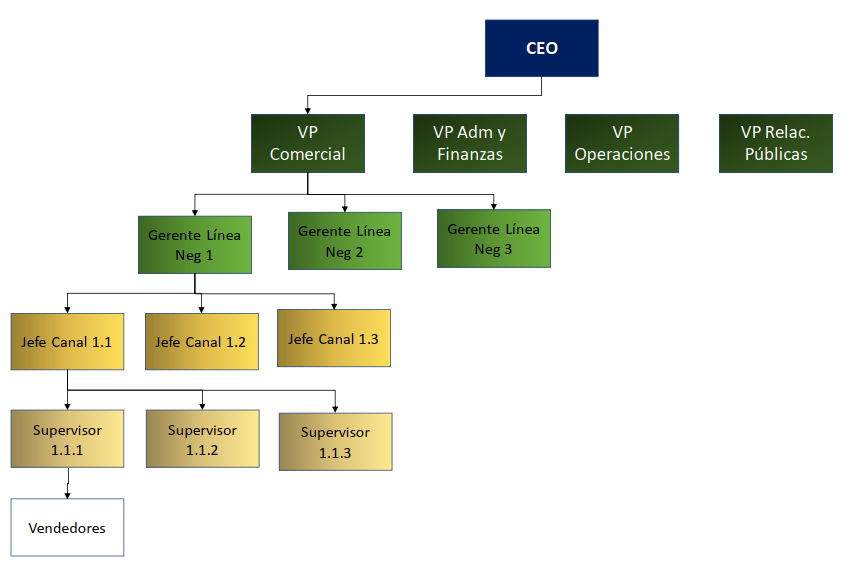 It is important to keep in mind that the matrix structure does not have to add organizational levels.
About the boss/subordinates ratio, scope of control or span of control.-
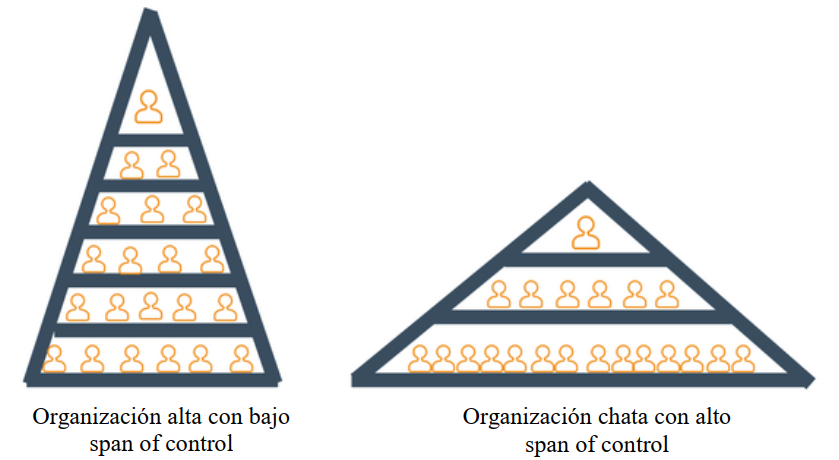
Another key variable is the number of people a supervisor manages, on average. By supervisor we mean anyone who has people in charge. Our experience tells us two things that are key to keep in mind:
- If the people in charge do basically the same job, for example, a Coca-Cola supervisor who is in charge of salespeople in the retail channel, it is assumed that the limit of supervision is given naturally by the ability to meet periodically with said The geographical dispersion of the vendors would be in this case the most limiting variable. But we have seen cases of supervisors with 30 or more people in charge, doing an excellent job.
- If the people in charge do fundamentally different jobs, for example, a general manager who is in charge of finance, legal, operations, etc., it is estimated that the scope of control of said supervisors should be between 6 and 8. This is a rule of thumb, that is, a widely applied principle or criterion, with considerable international consensus.
An important factor to take into account at this point is that a higher span of control requires, in many cases, the strengthening of supervisory positions. In other words, for the supervisor to be able to control more people efficiently, he or she must have the profile and the tools to do so. That is why the expansion of the scope of control usually brings with it the change of some key positions and internal training processes.
The profile of the employees. –
As the Harvard Deusto Business Review points out in its article The importance of structure and organizational design as sources of competitiveness (2019), the structure can have very significant effects on its members and vice versa. Due to the great diversity of people who work in organizations, not all workers fit in the same way in the different structural configurations. For example, not everyone handles flexibility and empowerment well. Some people are more satisfied and productive when their activities are standardized and there is no room for ambiguity. That is to say, there are people who fit better in simple structures, others perform better in professional bureaucracies and others are more productive working in a team. Organizational structures are not independent of the people who work in them. Therefore, the evaluation of the effects of organizational structure on employee behavior cannot be carried out without considering individual differences. A finding of numerous investigations is that specialization at work has the effect of greater productivity, but, yes, it negatively influences job satisfaction. Of course, this evidence must be interpreted with care, knowing that its validity is relative if individual differences and the type of activity in question are not taken into account (source: Horton (1991)). The relationship between the degree of centralization and job satisfaction has also been studied. Research shows consistent results linking a low level of centralization and greater participation in decision-making processes. And there is a positive correlation between participatory decision making and job satisfaction. Again, not forgetting individual differences.
One last important thing to note is that there is a relationship between employee self-esteem levels and satisfaction with the degree of centralization in the organization. Thus, low levels of self-esteem are correlated with high levels of centralization, which is explained by the fact that individuals with less confidence in their abilities feel more comfortable with shared decision-making.