
Reformulating the strategy: The opportunities that appear in the uncertainty
By: Ari Blumenfeld
The pandemic arrived and moved everything.-
Six months into one of the most challenging years in business history, mental clarity has become the most precious resource. We all know that Covid-19 is having a profound impact, but how things will play out in the next 6-12 months remains highly uncertain.

The daily information we receive about everything that has changed and what will change floods and stuns world leaders. The focus on protecting your people and getting back to work amid deep uncertainty is leaving little time for heads to step back and think together as a team what a new world is emerging and what that means for your business. What we do know is that the strategy that was in place in January is no longer relevant. Nobody planned for the peaks and valleys of demand and the supply shocks that have occurred in 2020. The changes that we are seeing at the level of customers, competitors and markets will inevitably alter the central assumptions of the initially outlined strategy. Did you have three years to build your digital channel? Forget it; it is no longer sustainable. Were you comfortable with your dependence on global markets, both for revenue and supply chains? Be careful; Now that’s a long shot. Do you intend to continue postponing the internal organizational efficiency project? Give it a second thought.
On the other hand, taking the “wait and see” approach is a tempting option. However, we also know that the time to act is now, both to adapt to the changes that have already occurred and to speed up the recovery. History is unequivocal in showing that winners and losers are forged in the midst of turbulence. After the global financial crisis of 2008, for example, companies that had a clear plan to pursue opportunities in the maelstrom largely separated themselves from the rest over the next decade. Fate was not kind to the stragglers. After the crisis, 40% of S&P 500 companies dropped out of the index because their performance fell. Given the current level of economic disruption, we wouldn’t be surprised if the churn rate was over 50% this time.
Rethinking the agenda.-
Most companies will need to modify their strategy to prepare for a future defined by uncertainty. And they will require three key skills: Prediction, Adaptation and Resilience.
In classic strategic planning exercises, most companies emphasize prediction at the expense of adaptation and resilience. But the current crisis reminds us that balance is essential: better forecasting alone will never be enough. Organizations need to be significantly more resilient against a broader set of shocks and much more adaptable to rapidly changing circumstances.
a. The ability to predict
It is easy to assume that the net effect of the pandemic will be that existing trends, such as the increased penetration of e-commerce or the growing use of video conferencing, have accelerated. That acceleration is real and will have a big impact, but it would be a trap to believe that the changes will end there.
Companies with a good predictive mechanism never assume that what they are doing today will work in the future, knowing that incremental changes will only get them so far. So they adopt the scenario approach as a fundamental part of their strategy; define and track the signs (or fronts) that might best signal change and develop an action plan that can be executed as the future begins to unfold.
Here are six fronts on which predictive scenarios can be considered:
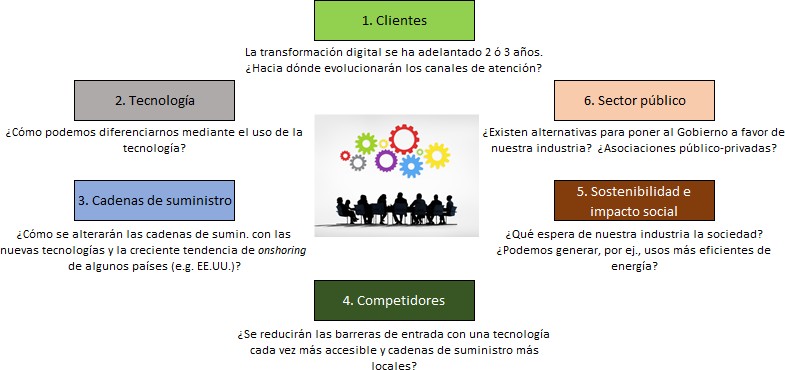
In short, the goal is not to plan for each undesirable scenario exhaustively, but to proactively consider potential impacts and determine specific investments that will help us respond more effectively if they occur.
b. The ability to adapt to changes.-
The ability to spot signs of change and respond to them quickly is how the best companies stay relevant year after year, no matter what. During the pandemic, we have seen that organizations under duress can react faster and more decisively than we ever thought possible. Business leaders can take advantage of this in a number of ways.

b1. Maintain a sense of urgency: One of the consequences of the current crisis is that organizations are achieving goals in a matter of weeks that used to take months or even years. There is more action and less planning, more willingness to kill sacred cows and less tolerance for endless deliberation. But heroics are also exhausting, and as the crisis drags on, it will be tempting to return to the old comfort zone. It’s going to be very important, then, to focus on learning throughout this process, to ask yourself what worked and what didn’t, and to focus on ways to maintain speed and decisiveness.
b2. Rethink management and operations models: today it is more important than ever to have simplified processes, suitable organizational structures, clearly defined operating policies, and implemented and permanently monitored controls and indicators. Maintaining a lean culture is essential to have as much air as possible in the lungs of the organization. The arguments “we are certified by ISO, why should we think about this?”, or “we have invested a lot in SAP, are no longer valid; the single tool will generate the efficiencies we need.”
b3. Renegotiate contracts when possible: this is a good time to review the current contracts of the organization, both for products and services, and put together win-win negotiation cases, where the supplier benefits from a longer contract time and of a greater volume of business, product of the consolidation of several smaller suppliers, and the company benefits from a lower rate. The areas of transportation, communications, energy, storage, security and maintenance are some examples where contractual efficiencies can be achieved.
c. The ability to resist.-
The most resilient companies are making strategic decisions today that will build resilience over time. This requires attention to four key aspects of the business.

c1. Operations and supply chains: Historically, supply chain management has focused on rationalization, but the pandemic exposed the risk of concentrating supply in one or two large sources and thus limiting spare capacity. Resilience implies having a distributed set of providers and operations that diversify risk, as well as the technology that can provide the necessary degree of traceability.
c2. Balance Sheet and Cost Structure: A strong, flexible balance sheet and efficient working capital management are critical to resiliency. And while we’ve seen the danger of trading efficiency for risk, maintaining a position as the lowest-cost competitor provides flexibility to absorb demand shocks, especially in downturns.
c3. The Government and Regulatory Environment: Both governments and consumers are intensely focused on issues such as public health, harmful environmental externalities, privacy, and social impact. Resilience requires being on the right side of changes in these areas, anticipating their impact, and taking them into account when developing strategy.
c4. Human talent and the organization: Obviously, having a strong management team in a crisis is very useful, but it is also important to recognize that a rigid and isolated organization, with low commitment from all employees, is vulnerable. Developing agility, adaptability, and a strong belief in the company’s mission requires developing a new deal for talent. These needs often fall by the wayside as businesses scale and become more complex. Strong leadership is needed to nurture them and not cast them aside.
In summary.-
CEOs and boards of directors need to take time to assess how the world is changing and prepare their companies to act. Given all the information pouring into them on a daily basis, there is a real risk that each member of the leadership team will think differently about how to respond to a highly uncertain future. Overcoming this discrepancy is essential to move forward in a cohesive manner. Leaders need to take time to assess what trends have accelerated, what new behaviors are emerging, and how structural assumptions have changed.
But then the conversation must conclude with a new agenda for action. Don’t get obsessed with reaching consensus: you need alignment on the questions, not the answers. Some things will be very clear; others will need more exploration. The job is to identify and prioritize the most important questions and commit to aggressively seeking answers. What is clear is the new strategic imperative: in a turbulent and disorienting time, it is essential to build strength by striking the right balance between predictability, adaptability, and resilience.
Sources:
(1) Retooling strategy for a post-pandemic world, Bain & Co, Jul 2020
(2) Amid unprecedented uncertainty, planning won’t be enough, Mc Kinsey & Co, Jul 2020
(3) Stretch or safe? The art of setting goals for your teams, strategy + business, Sep 2020