
By: Jonás Spellman
Luggage is one of the best indicators to show how international travel has changed over time. Adventurers in the 15th-century Age of Discovery set sail in galleons loaded to the rail with supplies for voyages that could take years. Eighteenth-century European aristocrats would traverse that continent for months in horse-drawn carriages, packed with trunks, servants, and even furniture. The suitcase arrived at the end of the 19th century, when spending several weeks abroad became more common for rich people; but the trips were still by ship. Then came the plane, which made shorter trips possible and, as a consequence, less need for luggage to carry. And so, finally, the wheeled carry-on arrived in the late 20th century to symbolize the age of mass travel.
The exponential increase in the use of carry-ons around the world reflects the falling cost and increasing speed of long-distance travel. Cheaper airfares, rising per capita incomes and more leisure time have made foreign travel routine, and a vacation abroad within reach of many who want to escape their daily stress. Traveling brings new experiences and memories – or at least moments to capture on Instagram. And if not all minds expand, at least few suffer the opposite effect. As Mark Twain said, “Travel is fatal to prejudice, bigotry, and narrow-mindedness.”
The ease of travel has not only expanded tourism. As companies have spread across the globe, so have their workers. Business travel keeps multinational companies and supply chains connected. And the ability to escape has allowed people to spread out across the world to work, learn, or just for a change of scenery. As families have spread out, so has the need to keep in touch or attend weddings and birthday parties abroad.
The crucial role of the airline industry.-
Until before the plane, travel was slow, difficult and expensive. The bulk of the trips were by sea, where they depended on the wind and an exorbitant use of horsepower. Steam and railways opened the gates a little wider. But getting far, even 100 years ago, required an ocean liner, which is an extremely expensive way to go. As an example, a first-class cabin on the Titanic in 1912 cost the equivalent of $3,500 today. The great increase in international travel occurred with flights. A train on the Trans-Siberian route from Beijing to Moscow takes more than five days; a flight covers the route in seven hours. However, the real game changer was the cheaper rates. In 1950, only 25 million people took a trip abroad, according to the United Nations World Tourism Organization (UNWTO). By 2019, the number of trips had risen to 1.5 billion, and that figure does not include migrants, refugees and visits of more than a year.
Nearly 60% of international travel worldwide in 2019 was by plane, compared to just 5% by sea and 1% by train, according to the UNWTO. 35% of travelers who crossed borders by car were mostly Europeans, inhabitants of the world’s largest travel market, taking advantage of the small size of their continent and good roads. Vacations that year were the main reason for trips abroad, accounting for 55% of trips. Business trips represented around 11% of the total. Most of the rest went to visit family and friends abroad. Some traveled for religious reasons (2 million Muslims visit Mecca every year); and around 15 million people traveled seeking medical treatment.
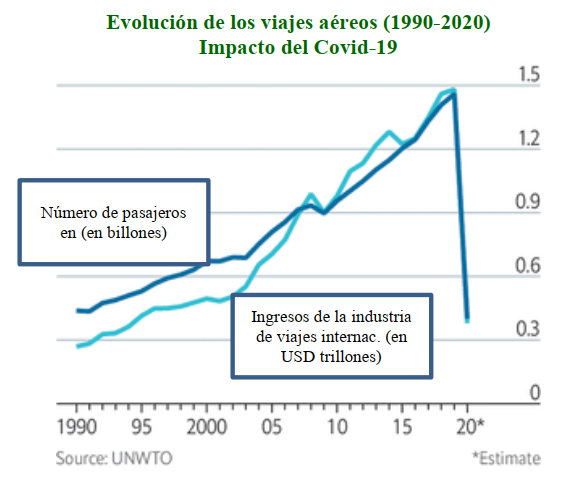
International travelers have filled the coffers of hotels, restaurants, car rental companies and tour operators. Its spending reached 1.5 trillion dollars in 2019. Before Covid, travel contributed 4.4% of GDP and 6.9% of employment in the club of rich OECD countries. International travel accounted for 6.5% of global exports in 2019, according to the World Trade Organization. In total, travel and tourism accounts for more than 330 million jobs, one in ten of the world total, says the World Travel and Tourism Council (WTTC). That’s how important this industry is.
However, the pandemic has devastated this gigantic economic activity that depends on people’s freedom of movement. International travel came to an almost complete halt between March and May 2020, as four-fifths of countries closed their borders. Forbidden or unable to move, the travelers stood still. International arrivals fell between 70% and 75% in 2020, estimates the UNWTO, with 1 billion fewer travelers and 1.1 trillion dollars less in spending (see graph below attached). That is ten times the impact that was generated in the international travel industry in 2009, after the financial crisis. And recovery seems a long way off, even with effective vaccines. The OECD forecasts that tourism will be among the last sectors of the economy to recover lost demand.
An optimistic vision, in spite of everything.-
However, not all bad news. Greenhouse gas emissions from commercial aircraft dropped dramatically in 2020, intensifying the debate about how to permanently reduce this pollution. Destinations blighted by over-tourism have had a break. And optimists acknowledge that, in the long run, the correlation between rising wealth and the need to travel will remain intact, if not grow. This article argues that despite its high costs in the short term, the pandemic may accelerate trends that will eventually make travel easier and less harmful. The current travel industry may have taken a hit, but the new one that emerges could be better and more sustainable than before.